Welcome, all participants, to the Shopee Ultimate Case Challenge Thailand 2026. In this year's edition you are given the case prompt below — please take your time to read the details.
You will be working progressively throughout the stages of the competition. Your team's final goal is to develop relevant, innovative, and actionable business plans for Shopee. You are free to apply both the materials provided with this case study and external data or observations to develop your solution.
We hope this year's challenge expands your business knowledge and lets you turn your academic and professional skills into insights and actionable solutions. Good luck!
What failed delivery is, why it hurts, and what causes it.
The questions to answer and what you need to submit.
Supporting exhibits that may help your analysis.
Shopee is the leading e-commerce platform in Southeast Asia, and part of Sea Limited, which also includes Garena, providing digital entertainment, and Monee, providing digital financial services. Shopee entered Thailand in 2015 and has since grown to serve a large majority of Thai online shoppers.
Shopee's model rests on three things working together: a wide product assortment from local small and medium enterprises (SMEs), brand official stores and overseas sellers; integrated payments; and integrated logistics. This case concerns the third.
When a buyer places an order on Shopee, the seller ships out the parcel. That parcel is delivered via our in-house logistics service (SPX) or through third-party logistics (3PL) providers such as Flash, Thaipost and others.
After an order is placed, the parcel is picked up from the seller (first mile), moved through sorting centres and line haul (middle mile), and finally brought to the buyer's doorstep by a courier (last mile), sometimes referred to as the last-mile rider or delivery person.
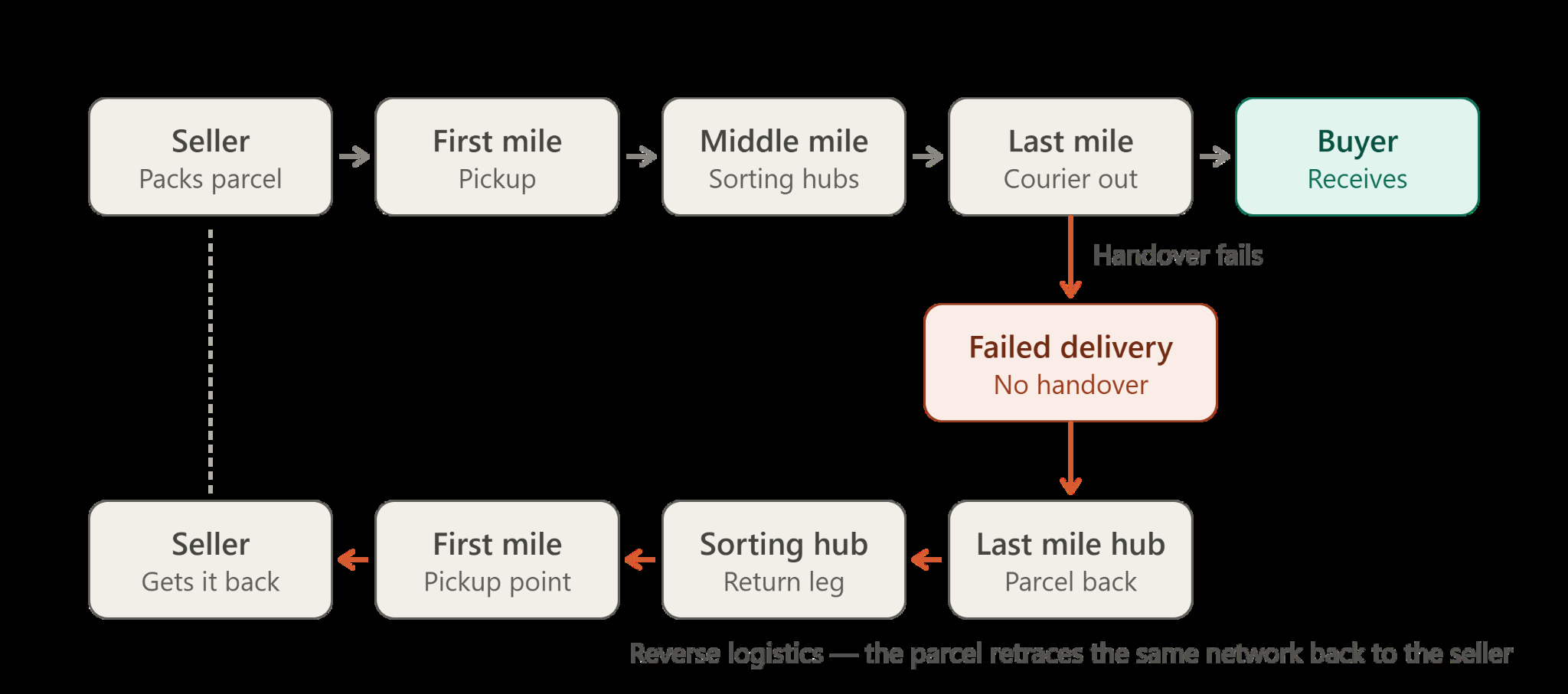
When the courier arrives at the buyer's address but the parcel cannot be handed over, the courier will typically re-attempt delivery a limited number of times. If every attempt fails, the parcel is declared undeliverable — a failed delivery — and enters reverse logistics, routed back through the network to be returned to the seller.
The order is then cancelled and the buyer is refunded (for prepaid orders) or simply not required to pay (for cash-on-delivery, "COD", orders). From the buyer's point of view very little has happened. From Shopee's point of view, this parcel has generated no revenue at all, and has incurred costs for both the forward and the reverse logistics.
Failed delivery is detrimental to Shopee for three compounding reasons.
When a delivery fails, the money spent moving the parcel to the buyer is entirely wasted — and Shopee pays a second time to move the same parcel back to the seller. Unlike a successful order, there is no commission, no GMV, and no satisfied buyer to offset that spend against.
| Component | Description | Cost per order |
|---|---|---|
| Forward delivery | Full cost paid to SPX or 3PLs to attempt the normal forward delivery. Usually based on a fixed rate card per parcel delivered, covering the courier's cost plus some profit margin. | 24 THB |
| Reverse leg | Cost to route the order through the courier's network back to the seller. | 20 THB |
| Total cost | 44 THB | |
The seller has already packed and shipped the item, held it out of their sellable inventory for the duration of the round trip, and receives it back — sometimes damaged in transit. Repeated failed deliveries erode seller trust in Shopee's logistics arm and in the quality of the demand Shopee sends them.
Since we can't guarantee that every item is returned to sellers in perfect condition, Shopee provides a process for sellers to claim for damaged items. If an item is lost during return transit, compensation is automatically triggered. To support sellers, Shopee pays them upfront and then files a claim with our logistics partner. However, this process often requires manual effort and can be time-consuming. In some cases, due to certain policies, Shopee may not be able to recover the claim from logistics partners, which results in a loss for Shopee.
The hardest part of e-commerce is convincing a buyer to place the order. In a failed delivery, that work is already done — the buyer wanted the product enough to check out. The value is then lost at the very last step, which makes it among the most frustrating forms of GMV (Gross Merchandise Value) loss on the platform. Shopee forgoes revenue it never gets to collect on that order.
| Component | Per failed delivery |
|---|---|
| Average order value | THB 600 |
| Shopee commission | 10% |
| Forgone commission | THB 60 |
The figures below show Shopee's orders and failed delivery trends over recent months.
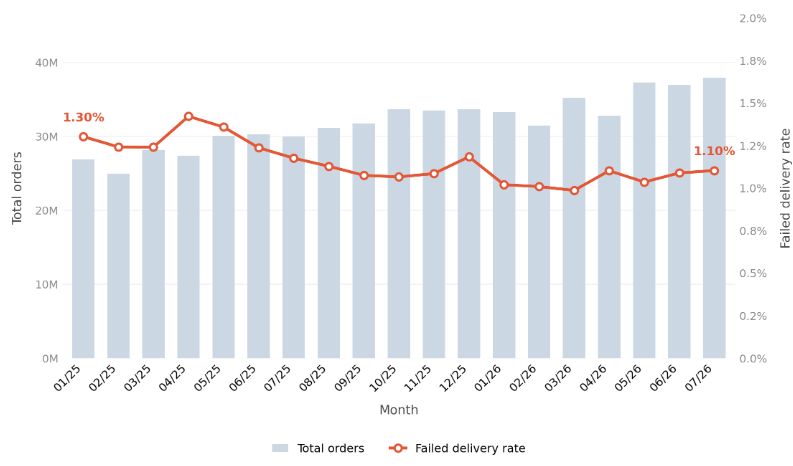
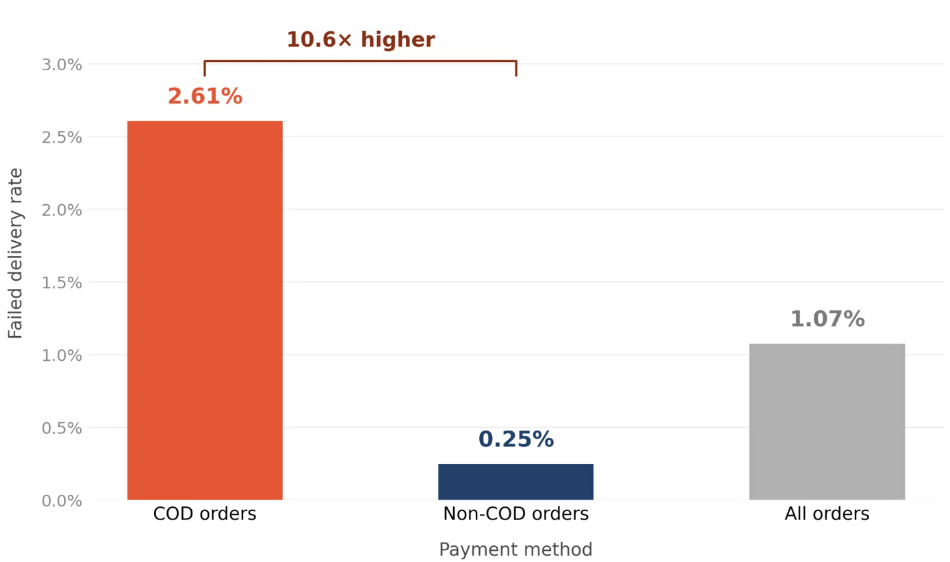
We also saw that failed delivery likelihood is highest for Cash on Delivery orders.
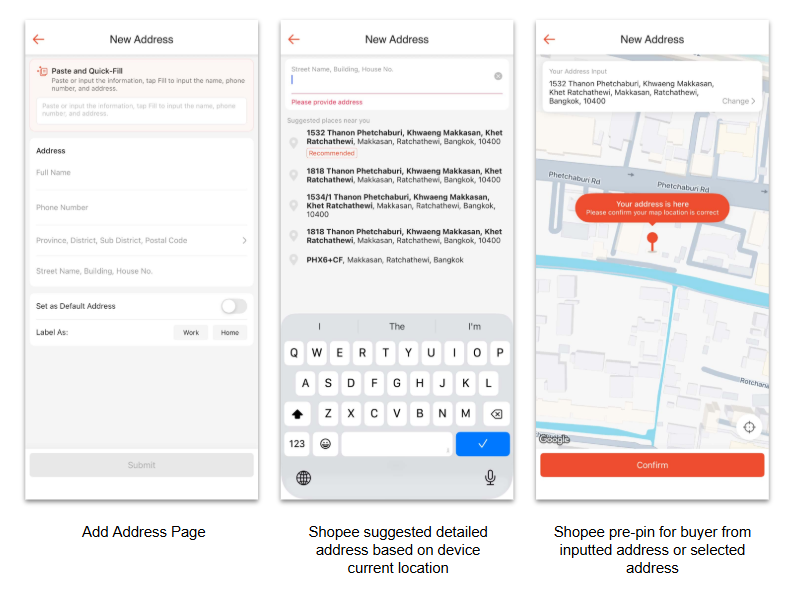
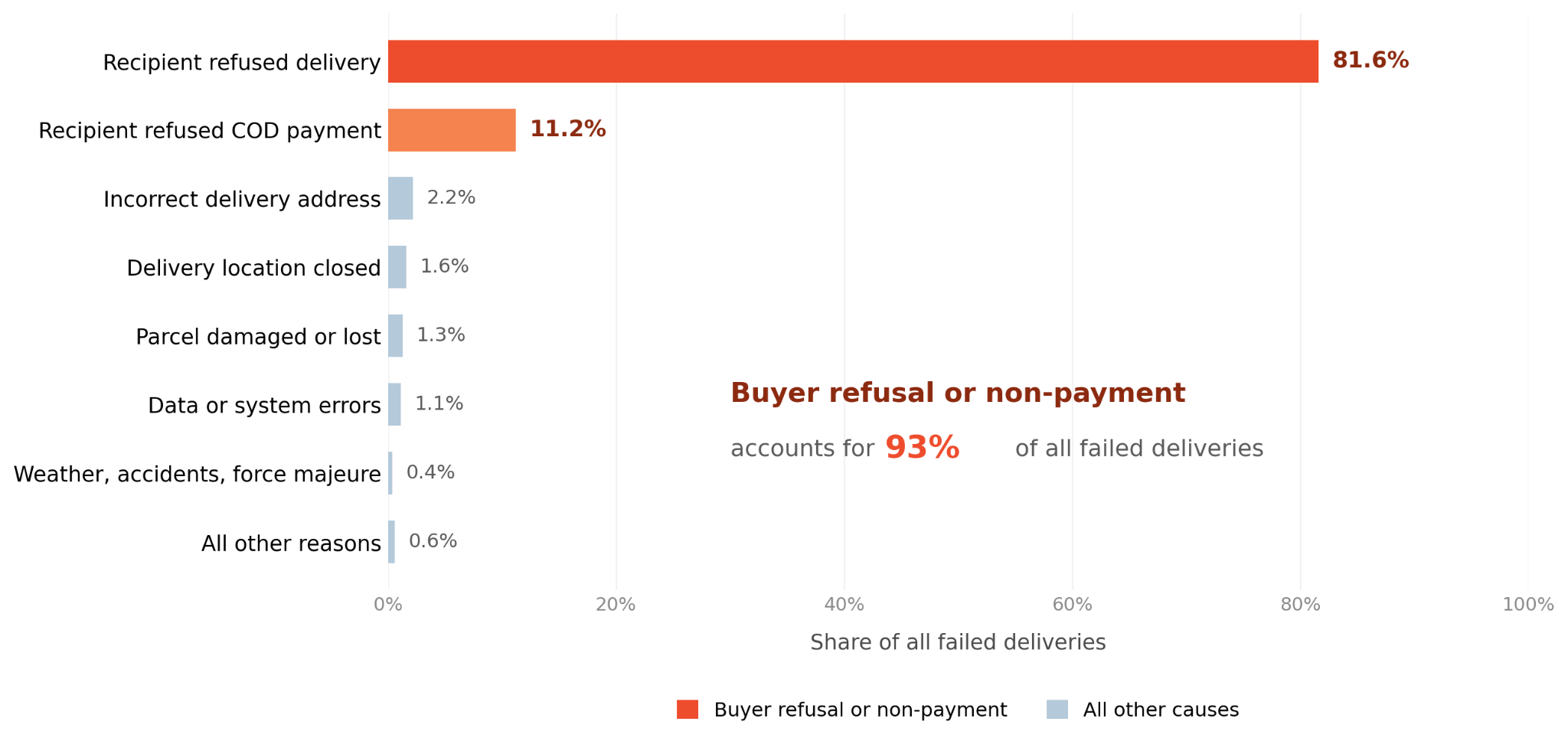
Across both COD and non-COD orders on Shopee, failed deliveries trace back to several broad root causes, as reported by 3PL and SPX couriers on the fail reasons.
Your task is to help Shopee reduce failed delivery rates and the cost they generate — without sacrificing the buyer experience and order volume that Shopee has built over years of scaling up our operations and building both buyer and seller trust.
In your group, address the following questions:
Where should Shopee Thailand focus? What is the potential size of the prize?
What should Shopee Thailand do about COD?
How do you ensure that buyer and seller have a good experience in the event that a failed delivery happens?
In the age of AI, what opportunities do you think AI can provide to solve the problem of failed delivery?
In PDF or PowerPoint format. Google Slides submissions are not allowed.
Presenting your team's solution.
Supplemental exhibits for this case.
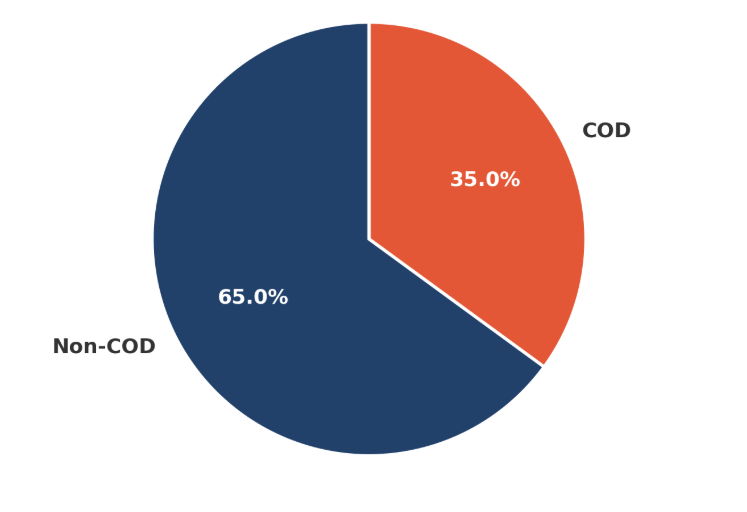
The chart above shows the breakdown of payment channels used by buyers across Shopee orders. COD refers to cash on delivery, whereby the buyer pays when the courier delivers the parcel to them. Non-COD includes various prepaid channels such as credit and debit cards, mobile banking, QR PromptPay, and others.
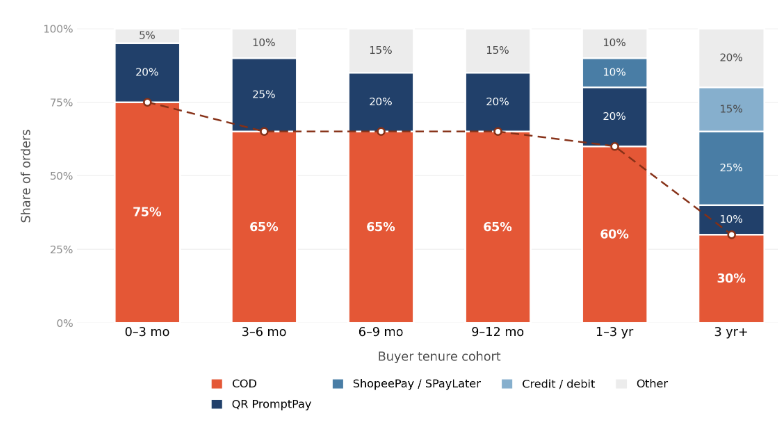
The chart above shows the preferred payment methods used by buyers on Shopee based on their tenure — that is, how long since they first registered as a user on Shopee. Other channels include miscellaneous payments such as mobile banking, credit card points, and Google Pay.
One part of your task asks how Shopee could use AI to reduce failed delivery. We are including this section because "AI" has become a term that means very different things to different people, and we want every team to start from the same understanding.
You are not expected to know how to build a model, write code, or understand the algorithm. You are expected to reason clearly about what AI could realistically do with Shopee's data, and what it could not. A team with no technical background can score extremely well on this section by thinking carefully. A team that uses AI as a magic word will not.
At its core, AI learns patterns from historical examples and applies those patterns to new situations. It is not programmed with rules by a human; it infers the rules from data it has been shown.
A useful way to think about it: if you personally looked at 10 million past Shopee deliveries — the addresses, the phone numbers, the payment methods, the buyers' order histories, and whether each delivery succeeded or failed — you would start to notice patterns. Certain kinds of address are trouble. Certain combinations of factors go wrong more often. AI does this at a scale and speed no human could, and it finds patterns subtle enough that a human would miss them.
Two broad families of AI are relevant to this case, and they are frequently confused.
Learns from labelled historical examples to estimate an outcome for a new case. Shown a million past deliveries and whether each succeeded, it can estimate the probability that a new order will fail. Output is typically a number — a score, a probability, a category.
Produces new content — text, images, code — and can interpret unstructured input such as free text or images. ChatGPT and Claude are examples.
"AI means a chatbot."
A chatbot is one narrow application. Most of what AI does in a business like Shopee is invisible to users — ranking search results, detecting fraud, forecasting demand, scoring risk. If your solution is a chatbot, ask honestly whether a conversation is really what the problem needs, or whether a silent prediction that changes what the buyer sees would work better.
"We will use AI to predict which deliveries will fail."
This is a starting point, not a solution. The real question is what happens next. A prediction that triggers no action creates no value.
"AI will be accurate."
No model is right every time, and being wrong has asymmetric costs.
"More AI is better."
Sometimes the right answer is not AI. Proposing AI where a simple rule would do shows weaker judgement, not stronger. It is entirely acceptable — often impressive — to say "this part needs AI, this part does not."
"The model will figure it out."
A model can only use information available at the moment it makes a prediction.
In each round, each submission will be evaluated out of 25 points. Adherence to the submission requirements is mandatory — submissions that exceed the stated slide or video duration limits may be subject to a deduction from the team's overall score. The evaluation criteria are as follows.
| Dimension | Elaboration | Max points |
|---|---|---|
| 1. Problem Diagnosis & Analytical Thinking | Demonstrates a clear understanding of the problem, identifies and prioritises the most important issues, and uses data and structured analysis effectively to support key conclusions. | 5 |
| 2. Solution Quality & Shopee Contextualisation | Develops a coherent recommendation that directly addresses the identified problem and is appropriately tailored to Shopee's business context. | 5 |
| 3. Business Impact & Feasibility | Demonstrates a clear understanding of the expected impact, key trade-offs and practical considerations required to translate the recommendation into action. | 5 |
| 4. Appropriate & Thoughtful Use of AI | Demonstrates thoughtful judgement on where AI can add value, with appropriate consideration of its limitations and suitability. | 5 |
| 5. Communication & Q&A | Communicates the proposed solution clearly, logically, and persuasively. Demonstrates a strong understanding of the recommendation through effective responses to questions posed by judges (for Semi-Final & Finals). | 5 |
| Total | 25 | |
Head to your dashboard to build your team and submit your deck and pitch video before the deadline.
